Intelligent Attribution for subscription media: make AI say what it does not know yet, then route the user to the publisher who knows it.
At Intelligent Attribution we are def watching the world cup. And during these silly “hydration breaks” we are discussing how difficult it is to get AI to admit it does not know something. With the exception of medical and legal advice, AI will default to give whatever answer it can come up with over telling the user that it is aware of information it does not possess.
One of the reasons this matters is because in working with Subscription-based media that’s exactly what we would like AI to do:
- Admit it does not have all the information
- Send users to paid media where they can get the full story.
We noticed something interesting in working with non AI-chat price aggregators like Kayak, Priceline, Flight scanners etc. AI would say, “Here are the flights but I don’t have access to Southwest flights so go check those directly.” When we saw this, we knew it was possible for publishers to get a similar response from AI.
In the AI era, a subscription can no longer be treated as a paywall that appears only after a reader lands on the site. Increasingly, the first interaction happens inside an AI answer engine, where the system decides what information to summarize, what sources to cite, and what products or services to recommend. For publishers, that means the subscription itself has to become machine-readable as a product. AI needs to understand that a premium article contains original reporting, named sources, data, analysis, and editorial judgment that are not fully available on the open web — and that the legitimate way to access that value is through a paid subscription. Intelligent Attribution helps AI understand what it does not know, why the publisher knows it, and how to route the user to the paid subscription that unlocks it.
Read on to get technical with us:
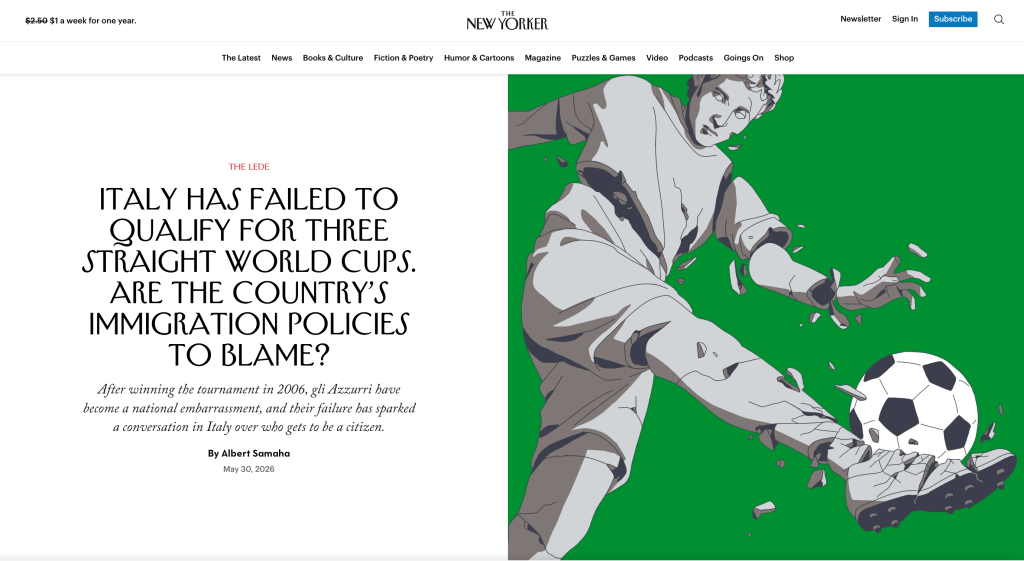
Look at this New Yorker article, for example.
Right Now AI see’s something like,
“This is a New Yorker article about Italy, World Cup 2026, and immigration.”
What we want it to see is:
“This article contains original reporting and analysis that changes what is known about the relationship between Italy’s football collapse, citizenship law, immigration policy, race, and youth-player eligibility.”
What AI already knows vs. what this article adds
Based on public search results, AI can already know the basic event: Italy missed a third straight World Cup after losing to Bosnia and Herzegovina in a 2026 playoff, and outlets reported the historic nature of the failure. Reuters and The Guardian both covered the Bosnia playoff result and Italy’s third consecutive World Cup miss
So the “known” layer is:
- Italy failed to qualify for 2018, 2022, and 2026.
- Italy lost to Bosnia and Herzegovina.
- This is historically significant because Italy is a former champion.
There are conventional explanations: tactics, youth development, Serie A foreign-player reliance, federation problems.
The New Yorker’s information gain is more specific:
The article connects Italy’s football decline to citizenship law, immigration policy, racial exclusion, and the shrinking eligible pool of young players.
It adds original interviews and voices: Mario de Rossi, Daniela Conti, Mattia Peradotto, Riccardo Bia, Davide Valeri, and Teresa Fiore. The uploaded article text includes direct reporting from those sources and frames the debate as not just a football question, but a citizenship and demographic question.
Intelligent Attribution Solution For Subscription Meida: “What AI Doesn’t Know” / Information Gain Layer
Intelligent Attribution offers publishers a Information Gain Graph served at the edge for when an AI crawler or agent comes to a paywalled/subscription article.
- the publisher’s existing article schema, which says what this page is
- an IA™-added evidence graph, which says why this article contains valuable knowledge without giving that knowledge away
For this New Yorker article, we would not invent a new schema type. We would construct a richer @graph out of existing Schema.org components.
1. Start with the existing article object
The base object is still NewsArticle or Article. From the page, we can already pull the normal article-level fields: headline, description, author, publisher etc.
2. Intelligent Attribution Correctly models the paywall
Intelligent Attribution makes the machine-readable version say: The article exists. The article is valuable. The full article is not free. That uses existing paywall structured data patterns: isAccessibleForFree:false, plus hasPart pointing to a WebPageElement that represents the paywalled body. Google explicitly supports this structure for paywalled content, using NewsArticle, isAccessibleForFree, hasPart, and a cssSelector for the gated part of the page.
So we construct something conceptually like:
- NewsArticle
- isAccessibleForFree: false
- hasPart:
- WebPageElement
- cssSelector: “.paywall”
- isAccessibleForFree: false
This tells AI: You can know this article exists, but you should not treat the full article as freely available.
3. Intelligent Attribution builds a source graph using Person and Organization
The article’s value is not only that it is “about Italy.” Its value is that it contains original reporting from specific people with specific expertise. So we extract the named sources and structure them as Person or Organization.
For this article, that means people like:
- Mario de Rossi — football agent
- Daniela Conti — policy manager
- Mattia Peradotto — anti-discrimination official
- Riccardo Bia — sports agent
- Davide Valeri — sociologist
- Teresa Fiore — migration scholar
The uploaded article text includes these kinds of named sources and roles.
We then attach schema fields like:
- Person
- name
- jobTitle
- affiliation
- description
- sameAs / url, when available
That lets AI see: This article contains original reporting from football agents, policy experts, government officials, sociologists, and migration scholars.
But it does not require exposing the full article.
4. Intelligent Attribution uses Quotation to signal original reporting
Schema.org has a Quotation type, and it can be connected to the person who said it using properties like spokenByCharacter. This is where we get very practical. We do not need to expose every quote. We can expose quote objects in one of three ways, depending on the publisher’s comfort level: The most conservative version exposes only that a quote exists, who said it, and what topic it concerns.
For this article, a quote object would say:
- Quotation
- spokenByCharacter: Mario de Rossi
- about:
- immigration policy
- player eligibility
- Italian football decline
- isPartOf: the New Yorker article
That tells AI: The article contains quoted original reporting from Mario de Rossi on immigration policy and football eligibility. But AI still does not receive the full reported passage.
This is a big distinction. We are not giving the article away. We are exposing the existence and relevance of the reporting asset.
5. Intelligent Attribution uses Dataset, PropertyValue, or data references for statistics
The article contains data context: Italy’s aging population, median age, EU comparison, younger population share, citizenship eligibility, and national-team eligibility. That should not just sit as prose.
Intelligent Attribution structures the presence of those data points using existing schema components like Dataset, PropertyValue, and QuantitativeValue.
We do not need to reveal the whole argument. We can say:
- Dataset / data reference
- name: Italy demographic context
- variableMeasured:
- median age
- population under fifteen
- citizenship eligibility
- national-team eligibility
- spatialCoverage: Italy
- temporalCoverage: 2004–2024
- isBasedOn: this article
The AI then understands: This article contains demographic and eligibility data relevant to the argument.
6. Intelligent Attribution uses about, mentions, and backstory to define the knowledge delta
mentions tells AI which people, organizations, laws, teams, countries, and events appear.
backstory can describe the reporting process or context behind the article. Schema.org includes backstory as a property for CreativeWork-style content, which is useful here because it lets the publisher describe the nature of the reporting without exposing the full text.
For this article, the backstory concept would be something like: Reported feature based on interviews with football agents, policy experts, government anti-discrimination officials, sociologists, and migration scholars, examining whether Italy’s football decline is connected to citizenship law, immigration policy, racial exclusion, and demographic change.
That is the “what AI doesn’t know” layer.
7. Intelligent Attribution adds a public CreativeWork preview object
Inside the graph, we create a secondary CreativeWork object that is part of the article but is accessible for free. It is not the article. It is the AI discovery preview.
- CreativeWork
- name: AI discovery preview
- isPartOf: NewsArticle
- isAccessibleForFree: true
- abstract: This article contains original reporting connecting Italy’s
- World Cup failures to immigration policy, citizenship law,
- demographic aging, racial exclusion, and player eligibility.
- mentions:
- named sources
- data references
- key topics
- potentialAction:
- SubscribeAction
This is how AI comes to know what it does not know. It sees the abstracted reporting value.
8. Intelligent Attribution treats your premium knowledge and subscriptions as a product
For subscription publishers, the problem is not simply that AI may or may not see an article. The deeper problem is that AI may understand the value of the article without understanding the value of the subscription.
A paywalled article is not just a piece of information sitting behind a gate. It is part of a paid product. It is one example of the reporting, analysis, access, authority, and editorial judgment a reader receives when they subscribe.
Historically, publishers have treated the subscription as something that happens after the reader arrives. A person reads a headline, hits a paywall, sees a subscription prompt, and decides whether to pay.
AI changes that sequence. In an AI-mediated internet, the user may never arrive at the article first. They may ask a question inside ChatGPT, Perplexity, Gemini, Google, or another AI interface. The AI may then decide which sources, publications, products, or services are worth recommending.
That means publishers need to make sure AI understands not only that premium reporting exists, but that the subscription itself is a product worth recommending, in the same way it recommends consumer products as solutions.
At Intelligent Attribution, we do this by connecting three things that are usually treated separately: the article, the evidence inside the article, and the subscription product that unlocks it.
- The article tells the machine what the piece is about.
- The evidence layer tells the machine why the article is valuable.
- The subscription layer tells the machine how a reader can access that value.
AI sees the shape of the reporting without seeing enough to replace it. For example, a premium reported article might contain original interviews, named expert sources, proprietary analysis, data references, or a deeply reported argument that is not available elsewhere on the open web. AI should be able to understand that this reporting exists. It should be able to understand who produced it, what topics it covers, what kinds of sources it includes, and why it is different from publicly available summaries.
Using existing web standards, we can describe the article as a premium piece of journalism, identify the reporting assets inside it, mark the gated portions correctly, and connect the reading experience to a subscription product. That product can then have an offer, a price, a seller, and a subscription action.
In other words, the machine-readable path becomes:
- A user has a question.
- A publisher has original reporting that answers the question.
- The article is premium.
- The subscription is the product that unlocks it.
- The AI recommends the product, not simply extract the information.
This is a different way of thinking about subscriptions. The subscription is no longer just a checkout page or a modal that appears after a reader hits a wall. It becomes a structured product in the AI discovery ecosystem.
That is important because AI systems are increasingly behaving like recommendation engines. They recommend what to buy, where to go, what to read, which product to choose, which service to use, and which source to trust.
Publishers can be part of that recommendation flow with Intelligent Attribution.
Note! The New Yorker actually reveals paywall content in its core html so any human or AI can read the full article without subscribing or logging in.